
Therapy for avoidant attachment style can help shift patterns that make closeness feel unsafe, patterns that often show up in ways that are deeply confusing, even to the person living them: the pull toward closeness followed by an urgent need to retreat, a fierce independence that keeps people at arm's length, and a discomfort with vulnerability that no amount of desire for connection seems to fix. These are not character flaws. They are patterns, learned early, that have simply outlived their original purpose.
The encouraging news is that working with an attachment-aware therapist can support meaningful change in attachment-related behaviors and relationship patterns. Not overnight, and not by forcing emotional openness you are not ready for, but through a steady, compassionate process of understanding where these patterns came from and what they are costing you now. This article covers what avoidant attachment looks like in practice, why it forms, how therapy works to change it, what to practice between sessions, and what realistic change looks like over time.
Key takeaways
Recognizable patterns: Pulling away when relationships deepen, discomfort with dependency, and shutting down during conflict are hallmark signs of avoidant attachment.
Origins, not character: These patterns develop as adaptive responses to early caregiving, not as personality defects.
Therapy options: Attachment-focused therapy, psychodynamic therapy, and Emotionally Focused Therapy (EFT) each offer meaningful support for relational avoidance; EFT has particularly strong evidence for relationship outcomes, while CBT effectively targets associated anxiety and depression. Effects on attachment patterns specifically vary by modality.
Realistic timeline: Early awareness builds within 1 to 3 months; meaningful behavioral change typically takes 1 to 3 years of consistent work.
Daily practice matters: Small, repeated steps such as naming feelings and using pause-and-return communication produce more change than rare moments of dramatic openness.
Low-stakes start: A free consultation with Kayla Meyer LPC is an accessible first step toward lasting change.
What avoidant attachment actually looks like in adult relationships
Signs you might recognize in yourself
You want closeness. And when it arrives, something tightens and you pull away. That paradox sits at the heart of avoidant attachment. Behaviorally, it shows up as a strong preference for handling problems alone, discomfort when a partner leans on you emotionally, or a vague sense of feeling suffocated in relationships that are otherwise going well. Expressing your own needs can feel disproportionately vulnerable, as though the stakes of being seen are much higher than they logically should be.
Emotionally, there is often a quieter belief running underneath the surface: that depending on others leads to disappointment, or that needing someone signals weakness. You may experience genuine loneliness while simultaneously pushing away the people who could help. That gap between what you want and what you do is one of the clearest signals that an avoidant pattern is at work.
How it plays out with the people closest to you
In practice, avoidant attachment shows up as staying busy to sidestep emotional conversations, shutting down during conflict rather than working through it, or gradually withdrawing as a relationship starts to feel more serious. It is worth distinguishing this from introversion, which is about how you recharge, not about closeness feeling threatening. The dismissive-avoidant tendency to minimize your own emotions, or others', is a relational pattern, not a preference for quiet time.
When one partner withdraws and the other pursues, an anxious-avoidant cycle forms quickly: pursuit intensifies withdrawal, and withdrawal intensifies pursuit. Both people end up stuck in a loop that leaves them feeling unseen, even when they both genuinely care about the relationship.
Why you developed this pattern in the first place
The role of early caregiving and family-of-origin experiences
Avoidant attachment forms as a smart adaptation, not a failing. When a child's emotional needs are consistently dismissed, minimized, or met with withdrawal, that child learns that reaching for comfort is unlikely to help and might even make things worse. Self-reliance becomes the safest available strategy. It is worth saying clearly: this is not a story of blame. Caregivers often repeat patterns from their own upbringing without any intention to cause harm. Families that valued emotional toughness, self-sufficiency, or achievement over comfort may have communicated that having needs was burdensome without ever saying so directly.
How a protective strategy becomes a lifelong habit
The challenge is that the strategy you developed in childhood follows you into adult relationships where the original level of danger no longer exists. Your brain keeps running old protective software in new relational situations. The habits that once kept you emotionally safe now keep others at a distance, even when closeness is genuinely what you want. Seeing this clearly is not self-criticism. It is the beginning of understanding your patterns with curiosity rather than shame, which is exactly the shift that makes change possible.
Therapy for avoidant attachment style: what the process looks like
What to expect from the start
Therapy for avoidant attachment style begins with an honest look at your current relationship struggles and the emotional patterns running underneath them. The early phase often involves something that sounds deceptively simple: building trust with your therapist. That relationship itself becomes a low-stakes, reliable place to practice something new. For avoidantly attached clients, depending on a professional for emotional exploration can feel just as uncomfortable as depending on a partner, and a skilled clinician anticipates this and moves at the right pace.
Kayla Meyer offers secure online individual psychotherapy for adults throughout Pennsylvania, using an attachment-focused, psychodynamic approach designed to help clients understand the emotional and relational patterns keeping them stuck.
Building emotional tolerance and practicing intimacy safely
The middle phase of therapy involves building the capacity to stay present with uncomfortable emotions rather than automatically deactivating them. That means learning to name feelings, tolerating vulnerability in small doses, and tracing how the relational dynamics in your family of origin replay in your relationships today. Boundaries and intimacy are worked on side by side, because avoidantly attached clients need to know that closeness does not mean losing themselves. Progress in this phase tends to look subtle from the outside but significant from the inside: staying in a difficult conversation a few minutes longer, noticing the urge to withdraw before acting on it, telling someone what you actually need.
Which therapy approaches have the best evidence
Attachment-focused and psychodynamic therapy
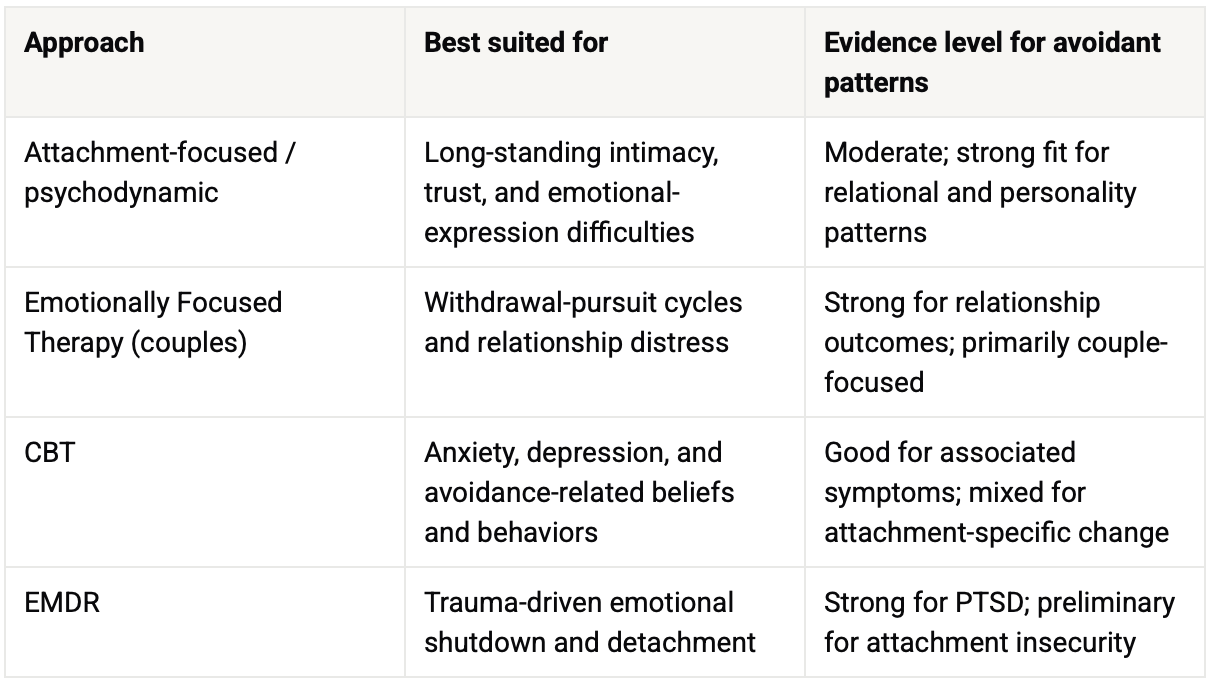
Attachment-based and psychodynamic approaches are particularly well-suited for avoidant attachment treatment because they address relational roots rather than surface behaviors. These approaches explore how early experiences shaped expectations about closeness, trust, and what it means to depend on someone. The therapeutic relationship itself becomes the practice ground: a consistent, boundaried experience of emotional engagement that can gradually revise older expectations. For long-standing difficulties with intimacy or emotional expression, this kind of relational treatment tends to be a strong fit, which is why it anchors the work at Kayla Meyer LPC. Research rates psychodynamic approaches as having moderate evidence for relational and interpersonal patterns, with the therapeutic alliance itself functioning as a core mechanism of change.
EFT, CBT, and other approaches worth knowing
Emotionally Focused Therapy for couples directly targets the withdrawal-pursuit cycle. Research on EFT outcomes, including meta-analyses of couple-based interventions, consistently finds meaningful improvement in relationship distress, with benefits that can persist well beyond the active treatment period. As a form of dismissive-avoidant therapy and attachment repair, EFT works by helping partners recognize and interrupt the cycles that keep them stuck. CBT approaches avoidant attachment through cognitive restructuring, including challenging beliefs like "closeness means losing freedom," graded exposure to intimacy, and communication skill-building. It has solid evidence for anxiety and depression, which often accompany avoidant patterns, though its effects on attachment specifically are more variable. EMDR is worth considering when emotional shutdown has roots in specific traumatic experiences; the evidence for PTSD is strong, and early research suggests some reduction in attachment insecurity, though this is not yet a fully established finding.
What to practice between therapy sessions
Daily exercises in therapy for avoidant attachment style
Small steps, repeated consistently, create more lasting change than rare moments of dramatic openness. A two-minute body check-in each morning, pausing to notice breathing, muscle tension, and the pull toward withdrawal, builds the awareness that precedes choice. Writing or saying "I feel ___, and I need ___" once a day starts to make emotional vocabulary more accessible over time. These attachment repair techniques are not grand gestures; they are the repetitions that gradually rewire what closeness feels like in your body.
Keeping a closeness log is also worth trying: record what you did, what you feared would happen, and what actually happened. Over time, the gap between the feared outcome and the actual outcome becomes hard to ignore. That gap is where the old protective strategy loses some of its grip.
Communication techniques to try this week
The pause-and-return approach replaces silence with a structured break: "I need 20 minutes; I'll come back at 8:15." That specificity transforms withdrawal into regulated space rather than abandonment, which matters enormously for the person on the other side. The emotion-need-request formula, "I feel ___ about ___. I need ___. Would you be willing to ___?", gives conversations a structure that makes them feel more predictable and, therefore, less overwhelming.
Scheduling brief, predictable connection time, 10 to 15 minutes daily, also helps considerably. Low-intensity, consistent contact is far easier to tolerate than rare, emotionally loaded conversations. Validation before explanation is another technique worth practicing: acknowledge what the other person feels before sharing your own perspective. You are not agreeing with them; you are signaling that their experience has been heard, which changes everything about how the conversation can unfold.
How long does it realistically take to heal avoidant attachment patterns
A rough timeline for what to expect
The first one to three months of therapy typically bring greater awareness of withdrawal strategies, an expanded emotional vocabulary, and early trust-building with your therapist. Between three and twelve months, many people begin noticing avoidance in real time and experimenting with staying present rather than retreating. After a year of consistent work, changes often start to generalize across close relationships, though deeper change continues to develop well beyond that point.
Couples-based EFT is commonly delivered over eight to twenty sessions and can produce measurable shifts in relationship distress within that window. Deeper individual attachment change typically takes one to three years of consistent work. These are honest estimates, not guarantees, and progress in symptom relief and relationship quality often shows up before a person's overall attachment pattern has fully shifted.
Factors that affect your pace of change
The rigidity and duration of the pattern matters, as does whether anxiety, trauma, or depression are also present. The quality of the therapeutic relationship is significant: feeling safe enough to experience closeness, disagreement, and repair within therapy itself is central to the process working. Consistency of attendance and real-world practice with partners, friends, and family help changes move from the therapy room into everyday life.
A useful benchmark: after ten to twelve sessions, track whether withdrawal feels less automatic, whether emotional recovery after conflict is faster, and whether asking for support feels even slightly less impossible. Progress is real even before the overall pattern has fully shifted. That forward movement is worth noticing.
You do not have to figure this out alone
Recognizing these patterns in yourself is already meaningful work. Being able to name what is happening, even imperfectly, means the awareness is already there. Avoidant attachment is not a life sentence, and it is not something you chose. It is a learned strategy, and like any learned strategy, it can be revised with the right kind of support and enough time to practice something different.
Adults throughout Pennsylvania who are ready to explore therapy for avoidant attachment style can work with Kayla Meyer LPC through secure online sessions. The approach is attachment-focused and psychodynamic, meaning the goal is not symptom management but genuine, lasting change in how you relate to yourself and the people who matter most to you. A free consultation is available as a first step, reach out when you are ready.
Something in you is already leaning toward connection, the very act of reading this far is evidence of that. That instinct is worth following.
Frequently Asked Questions
Can our partner join therapy, or should we do couples therapy instead?
If you and your partner want to address withdrawal-pursuit cycles together, Emotionally Focused Therapy (EFT) is the couples-focused approach best suited for that work. We note that couples-based EFT is commonly delivered over eight to twenty sessions and directly targets those interaction patterns, while individual attachment-focused or psychodynamic therapy focuses on your personal relational history and capacity for intimacy.
Could my avoidant behavior just be introversion rather than an attachment issue?
No, avoidant attachment is different from introversion. Introversion describes how you recharge, being energized by solitude, whereas avoidant attachment means closeness itself feels threatening and you pull away to protect yourself, which is a relational pattern rather than a preference for quiet time.
Can therapy still help if my emotional shutdown comes from trauma?
Yes, therapy can help when trauma contributes to emotional shutdown. EMDR has strong evidence for PTSD and preliminary evidence for reducing attachment insecurity, and other approaches like attachment-focused work can address relational roots of emotional detachment.
How can I bring up avoidant patterns with my partner without making things worse?
Start with predictable, low-stakes structures like the pause-and-return approach and the emotion-need-request format to make conversations feel safer. Also schedule brief daily connection time and lead with validation before explanation so the conversation feels heard rather than confrontational.
